
For a business, a fatigued audience isn’t one that is ready to engage with their brand. To cut through the noise, counteracting branding fatigue is necessary, and we’ve got you covered on that front.
But, there’s more to it than just advertising the right way. With the informational overload, comes the options and alternatives that your target audience can choose from.
A loud website, a slow loading page, a shopping cart that redirects to a new page or poor customer service and your buyer is off to click the next link. To keep up with an audience that is used to convenience and quick access, managing back end workflows is a necessity.
Traditionally workflows are human driven tasks that require decision making at every stage, with creative bottle necks and errors that ultimately lead to issues that affect buyer decisions. Fortunately, with AI processing and human ideation, agentic workflows are making processing simpler.

Agentic workflows are AI-powered systems where autonomous agents can interpret context, make decisions, and carry out tasks with minimal human input. Unlike traditional rule-based automation, such as RPA, which follows strict, pre-defined steps, agentic workflows adjust in real time.
They use capabilities like reasoning, planning, and tool interaction to navigate complex tasks, respond to new information, and continuously refine their output.
This adaptive, multi-step approach allows AI to break down complicated processes, learn from each iteration, and handle work that previously required constant oversight.
As generative AI, machine learning, and natural language technologies advance, agentic workflows are becoming a core driver of operational efficiency, smarter decision-making, and scalable automation across fields ranging from healthcare and finance to HR and software development.

Creating an agentic workflow involves integrating multiple technologies and architectural elements to enable AI-driven processes that can operate autonomously and adapt dynamically. The following are the key components that form the foundation of these intelligent workflows:
- Contextual Awareness & Data Management
Effective agentic workflows rely on comprehensive context to make informed decisions. This includes historical interactions, real-time inputs, user preferences, task-specific details, and environmental factors.
By understanding context, agents can respond appropriately, for instance, a customer support agent may consider previous interactions, current sentiment, and account status before taking action.
- Natural Language Processing (NLP)
Natural Language Processing allows agents to comprehend and generate human language. This capability is essential for interpreting emails, analyzing support tickets, summarizing documents, processing voice commands, and producing coherent written responses. NLP enables agents to interact intuitively with unstructured text and speech, creating more natural, human-like workflows.
- Autonomous AI Agents
At the heart of agentic workflows are AI agents, intelligent entities that plan, reason, and execute tasks independently. Powered by large language models and reinforcement learning, these agents pursue goals autonomously, adjust based on feedback, and continually refine their strategies to become more effective over time.
- Large Language Model Capabilities
LLMs provide the foundational reasoning, problem-solving, and language understanding that make AI agents effective. Adjusting parameters such as creativity or randomness influences the quality and style of outputs.
LLMs allow agents to interpret complex instructions, break down multi-step tasks, and produce contextually relevant results.
- External Tools & Resource Access
Agents extend their abilities through tools such as APIs, databases, web searches, internal applications, or specialized functions. These tools enable agents to gather information, trigger automated actions, update systems, and interact with real-world software, allowing them to handle a wide variety of use cases beyond basic tasks.
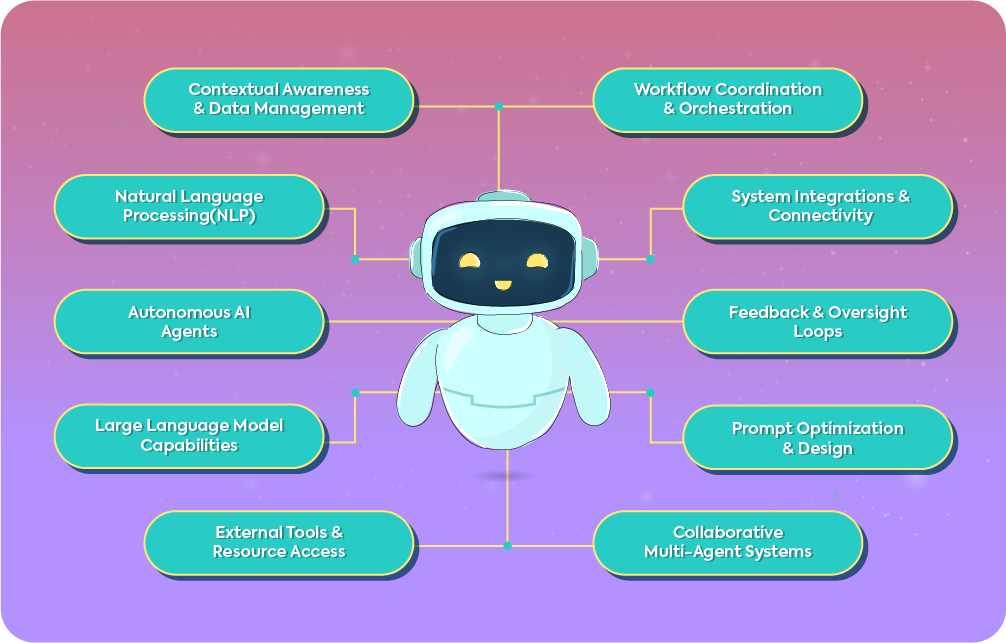
- Workflow Coordination & Orchestration
Orchestration ensures that agents and tools work together efficiently, managing task sequences, resource allocation, and communication flows. This structured coordination prevents chaos and keeps the workflow aligned with overall objectives.
- System Integrations & Connectivity
For agentic workflows to function effectively, they must integrate with existing systems, including CRMs, email platforms, calendars, databases, and enterprise tools.
Such integrations allow agents to take tangible actions, logging data, sending communications, scheduling events, or generating reports. Agent orchestration frameworks like LangChain, LangGraph, crewAI, and BeeAI facilitate these integrations at scale.
- Feedback & Oversight Loops
Continuous feedback helps agents improve their performance. This can include human-in-the-loop oversight for sensitive tasks or agent-to-agent feedback in multi-agent environments. Feedback ensures that outputs remain aligned with goals and allows for iterative learning.
- Prompt Optimization & Design
The quality of prompts directly impacts agent performance. Techniques such as chain-of-thought reasoning, zero-shot and one-shot prompting, and self-reflection guide agents to interpret instructions accurately, reason effectively, and handle complex queries. Effective prompt design is critical for reliable and consistent results.
- Collaborative Multi-Agent Systems
In complex workflows, multiple agents can work together, each with specialized tools, algorithms, and domain knowledge. Instead of duplicating efforts, agents share insights and distribute tasks, enabling efficient, scalable, and accurate problem-solving.

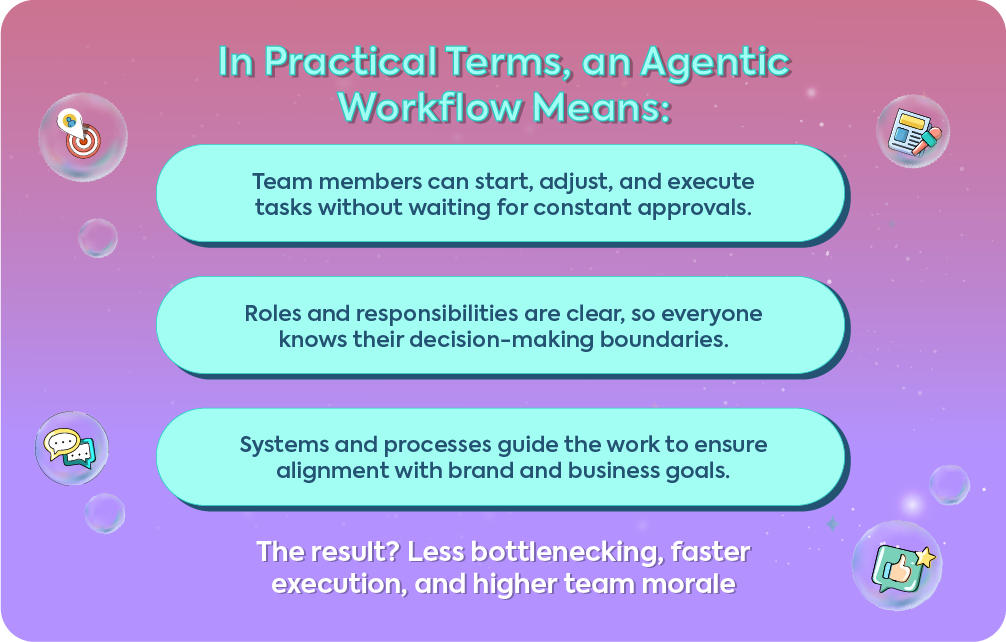
GitLab is one of the world’s largest fully remote organizations. To keep 1,300+ employees aligned across time zones, they built an agentic workflow system where team members can make decisions autonomously without waiting for approvals.
Their system includes:
- Detailed guidelines & handbooks so anyone can act without asking.
- Clear ownership for every task and decision.
- Async workflows that let teams operate independently.
- Documentation-first culture, enabling people to self-serve answers.

- Faster execution: Projects move without bottlenecks or delays.
- Higher trust + accountability: Teams own outcomes end-to-end.
- Scalable operations: They grew into a global company without adding layers of management.
- Greater creativity: People feel empowered to propose solutions, not wait for instructions.
GitLab is one of the best-known modern examples of a company using agentic workflows effectively, proving that structured autonomy can outperform traditional, approval-heavy systems.

If you’ve worked inside a creative team long enough, you know the real slowdown rarely comes from the creative work itself. It comes from everything around the creative work.
- Waiting for approvals.
- Meetings that disrupt flow.
- Unclear direction.
- Slack messages asking, “Quick question, what’s the final CTA style again?”
- Revisions that never end.
- And production tasks that eat up time creators could’ve used to actually create.
However, a major shift is happening across the creative industry. Teams are looking for systems that don’t just manage work, they remove delays and friction, altogether. This is where agentic workflows come in.
Agentic workflows empower creative teams to make decisions, move independently, and work faster, without constantly seeking permission or clarification.
This is how a creative team can incorporate agentic workflow for seamless operation and smarter outcomes.

One of the biggest blockers for creatives is missing information. When people can’t find brand rules, templates, or tone guidelines, they stop creating and start asking.
Agentic workflows fix this by creating a central creative brain, one place where everything lives.
Think:
- Brand guidelines
- Messaging rules
- Motion and animation standards
- File naming conventions
- Asset libraries
- Ad templates
- Approval workflows
When everything is clearly documented, creative work starts immediately instead of waiting for someone to answer a question.
A designer doesn’t ask, “Is our social layout 4px or 8px spacing?” They check the system and move.A writer doesn’t wonder if the tone is playful or authoritative, they reference the tone guide and start writing.
A motion designer doesn’t wait for direction on transitions; they open the animation rules and create.This kind of clarity builds creative confidence and reduces processing times significanty.

Creative work slows down when too many people review it and no one knows who has the final say.Agentic workflows introduce a simple but powerful concept: one Directly Responsible Individual (DRI) for every deliverable.
One owner.
One decision-maker.
One final call.
This doesn’t mean others can’t contribute. It simply means someone actually leads.
A brand designer owns the full direction for a campaign identity.A motion designer owns the pacing, transitions, and final look of an animation.A growth marketer owns the final decision for ad variations, not five stakeholders chiming in with conflicting feedback. Here clarity unlocks speed!

Meetings are important, but too many meetings will crush any creative team’s flow.Agentic workflows encourage async-first communication so creators can stay in deep work.
This looks like:
- Loom feedback instead of calls
- Figma comments instead of live reviews
- Google Doc or Notion briefs instead of kickoff meetings
- Slack clips instead of huddles
A writer submits a draft Friday night. The editor drops a Loom review Monday morning. The project moves without needing a single meeting.
A designer uploads WIP frames to Figma and gets annotated feedback later that day. No one’s morning is blocked waiting for a call. Async systems keep projects moving, even when people aren’t online at the same time.

Many teams create brand guidelines once, then never update them again. Agentic workflows flip this completely: documentation is always evolving. Every week, as the team learns something new, they update the system.
A motion designer perfects a new easing curve and adds it to the animation rules.A brand designer adjusts color accessibility standards and updates the guidelines.A copywriter refines the messaging pillars after testing new angles. Your creative system becomes a living organism, not a PDF buried in someone’s desktop.

One of the biggest mistakes creative teams make is spending too much time perfecting something before showing it. Agentic workflows encourage sharing smaller, faster, early-stage outputs, what we call micro-ships.
This could be:
- Rough logo sketches
- Early moodboards
- A script outline
- The first 10 seconds of a motion piece
- Low-fidelity layouts
- Early headline drafts
A brand designer shares six quick sketches instead of one polished direction. You get alignment before the heavy lifting. A motion designer shares a rough animation first. Timing and story get fixed before the full animation is built. Micro-ships save hours and sometimes weeks of rework.

Agentic workflows combine autonomy with automation. If a task doesn’t require creative judgment, it shouldn’t consume creative time.
What can be automated?
- Resizing 20 ad formats
- Exporting assets
- Content repurposing
- Version control
- Filling metadata
- File naming
- Subtitling
- Audio cleanup
- Publishing schedules
- Draft generation
A designer works on one master ad, and automation handles the resizing.A writer uses AI to generate a first outline, then adds the strategy and storytelling.A motion editor uses automated cleanup tools so they can focus on narrative and emotion. Automation isn’t replacing creativity its making

For Faster, Smarter & Autonomous Creative Teams
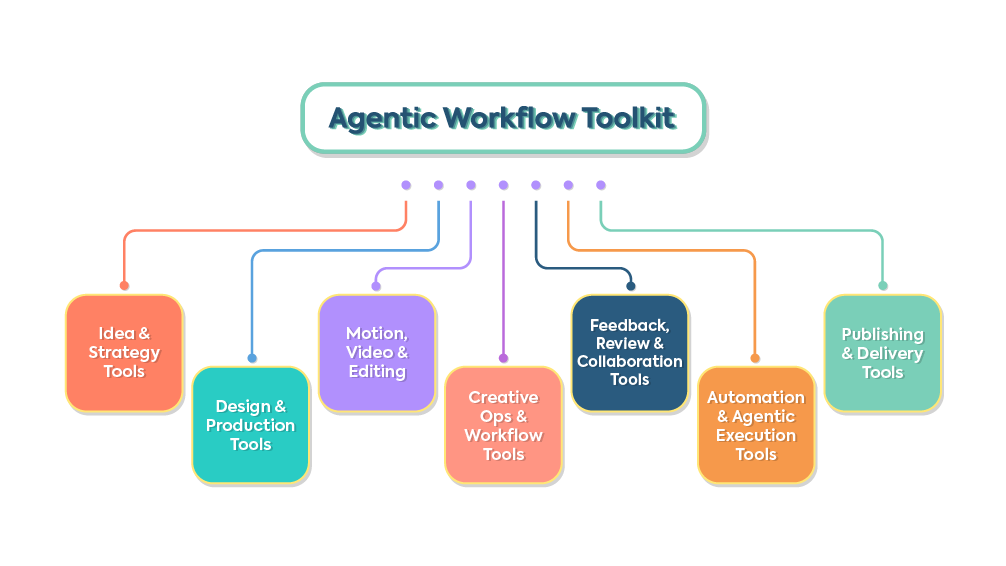
Agentic workflows help creative teams operate more independently, reducing meetings, removing bottlenecks, and enabling designers, editors, writers, and strategists to take action without waiting for approvals.
This toolkit gives you the exact tools required to build an agentic creative ecosystem.
Idea & Strategy Tools
Purpose: Give creatives clarity so work moves without supervision.
- Notion: Creative OS, briefs, guidelines, documentation
- Milanote: Moodboards & concepting
- FigJam: Workshops, flows, quick mapping
- Apple Freeform: Visual dumping & early idea exploration
Design & Production Tools
Purpose: Async design collaboration + independent execution.
- Figma: Libraries, components, shared styles
- ZeroHeight: Live design system
- Figma Plugins:
- Content Reel
- Iconify
- Automator
- Autoflow
- Artboard Studio: Mockups & brand visuals
- Canva Brand Kits: Branded content templates
Motion, Video & Editing Tools
Purpose: Speed up video/motion workflows, reduce manual edits.
- After Effects Scripts: Flow, MotionTools Pro, Overlord
- Runway: AI video generation & cleanup
- Pika: AI motion generation
- Descript: Video editing, audio cleanup, screen recordings
- Opus Clip: Auto repurposed short clips
Creative Ops & Workflow Tools
Purpose: Turn chaos into a structured, autonomous pipeline.
- Linear: DRIs, async progress, automations
- Asana: Creative ops & pipeline
- Trello: Simple Kanban
- Height : Task automation
- Notion Calendar: Content & production planning
Feedback, Review & Collaboration Tools
Purpose: Remove meetings. Speed decisions.
- Frame.io: Timestamped feedback
- Loom: Async creative direction
- Slack Clips: Quick updates when typing is too slow
Automation & Agentic Execution Tools
Purpose: Make workflows move without humans.
- Make.com: Multi-step automation
- Zapier: Trigger-based workflows
- Google Drive: Organized asset libraries
- Dropbox Business: Heavy creative file storage
Publishing & Delivery Tools
Purpose: Automate distribution so creatives stay creative.

- Designers pull brand libraries in Figma → create → publish directly
- Video teams use Runway for cleanups → Frame.io for async feedback
- Strategists write a brief in Notion → auto-creates tasks in Linear
- Social teams schedule posts in Buffer → content publishes automatically
- Project managers set Make.com automations so tasks move from “Review → Final” without manual nudges
This transforms your creative team into an autonomous, self-moving creative engine. Still unsure on how agentic workflow works?


What exactly is an agentic workflow?
It is an AI-powered system where autonomous agents interpret context, make decisions, and execute multi-step tasks with minimal human input. Unlike traditional rigid automation, these workflows adjust in real-time.
How does this differ from traditional automation?
Traditional automation (like RPA) follows strict, predefined rules. Agentic workflows use reasoning, planning, and tool interaction to navigate complex tasks and refine their own output.
Will AI replace our creative team?
No. Agentic workflows automate repetitive “busy work”, like resizing ad formats, subtitling, or file naming, so that your human creators can focus on strategy, narrative, and high-level creativity.
What is a DRI and why is it important?
A Directly Responsible Individual (DRI) is a single owner or decision-maker for a project. Having one DRI per deliverable prevents work from getting stuck in endless review loops.
What are “Micro-Ships”?
These are small, fast, early-stage outputs (like rough sketches or script outlines) shared for immediate feedback. They help teams get alignment early, saving hours or weeks of rework.
How does “Asynchronous Collaboration” help?
It uses tools like Loom or Figma comments to keep work moving without needing constant meetings. This allows creators to stay in “deep work” while still receiving timely feedback.