
SaaS companies that apply AI-based automation claim that operational costs can be reduced by 20-30%, especially in customer support and internal processes.
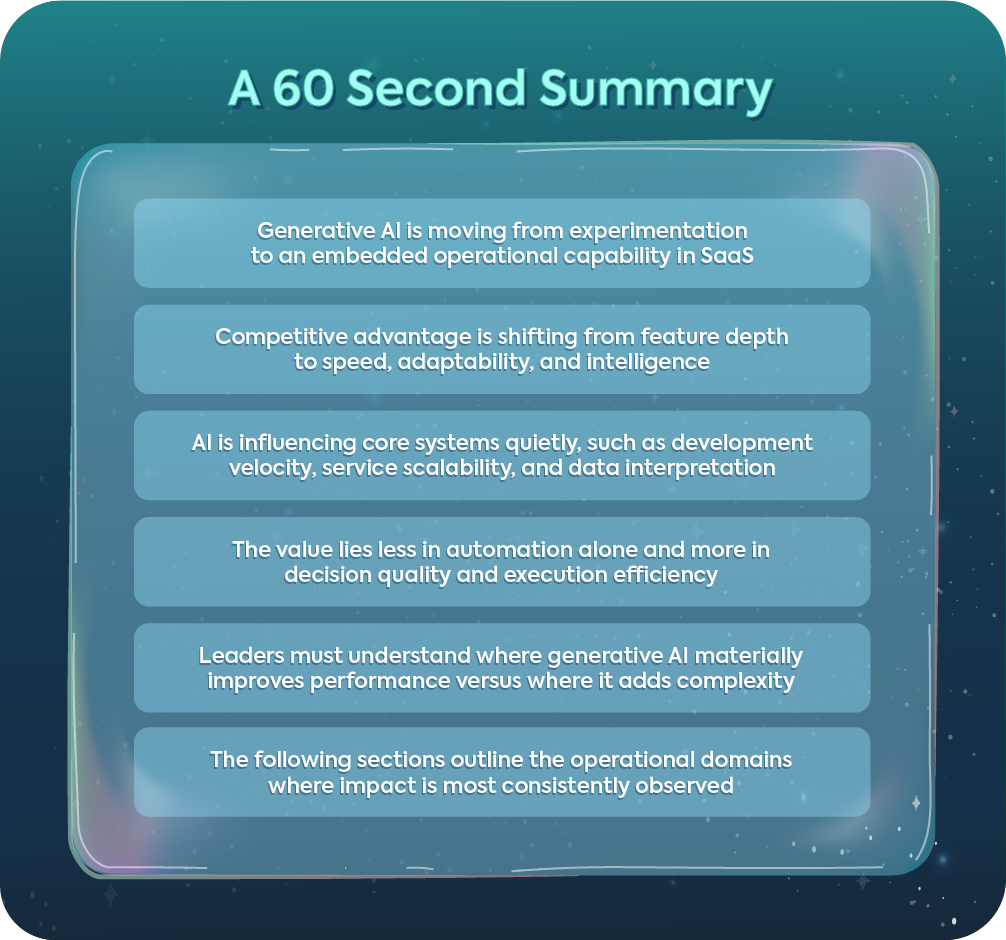
Salesforce data shows that clients prefer adaptive software over fixed solutions. While Gartner forecasts 80% of SaaS products will have AI by 2026, MIT Sloan shows 5–10% of early AI pilots deliver rapid returns.
These are promising numbers for SaaS companies, but also position generative AI as a necessity for these.

Generative AI has moved from experimental add-on to a structural advantage for SaaS companies operating in crowded, subscription-driven markets. Differentiation is no longer driven by features alone, but by intelligence, speed, and experience.

When implemented with intent, generative AI reshapes how software is built, how customers are supported, and how revenue scales. This shift is already visible across enterprise platforms through measurable operational gains and new monetization models.
This is not theoretical. Market data, platform disclosures, and real SaaS-AI partnerships already show tangible impact.

SaaS businesses operate under unique constraints:
- Recurring revenue models where value is evaluated continuously
- Low switching costs and high competitive parity
- Buyers who self‑educate, compare relentlessly, and expect constant improvement
In this environment, stagnation is expensive. Even minor delays in innovation can translate directly into churn.
Industry research consistently shows that generative AI is emerging as a response to these pressures rather than a speculative bet. Enterprise software leaders are integrating AI to improve operational efficiency, accelerate product velocity, and introduce adaptive experiences that fixed software cannot deliver.
Generative AI differs from earlier automation systems in its ability to:
- Generate original content and code
- Analyze unstructured data at scale
- Communicate through natural language interfaces
- Adapt outputs based on context and learning
As a result, AI is now influencing the full SaaS lifecycle, from product development to monetization.

Faster Product Development and Engineering Efficiency
Product velocity remains one of the strongest competitive levers in SaaS. Frequent releases and rapid iteration directly influence retention and long‑term relevance.
Generative AI supports engineering teams by:
- Producing boilerplate and scaffolding code
- Suggesting optimized logic patterns
- Generating technical documentation
- Assisting with unit and integration testing
Empirical studies from GitHub and MIT have shown that AI‑assisted development can improve developer productivity by roughly 30–40% on routine programming tasks. For SaaS companies, this translates into shorter development cycles and faster time‑to‑market without proportional increases in engineering headcount.
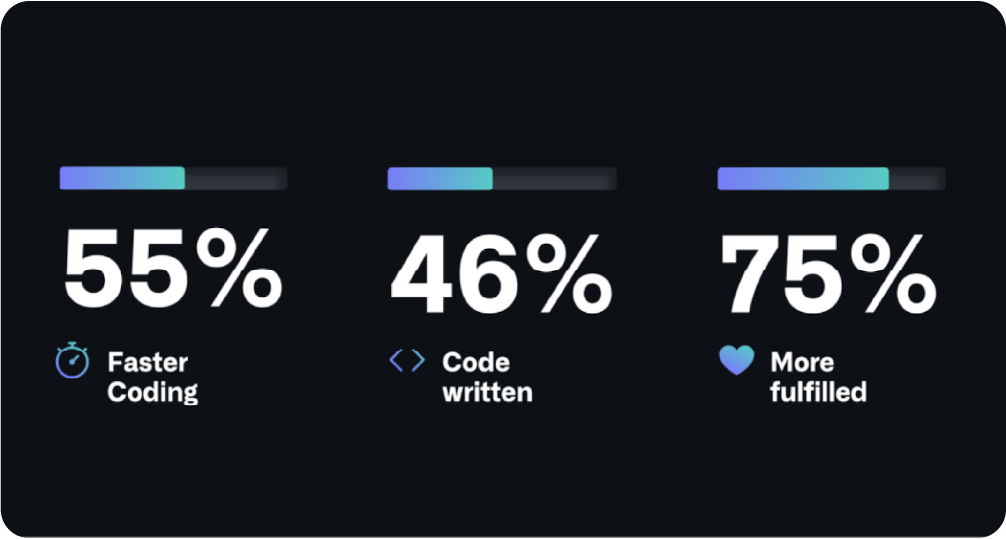
Beyond speed, AI also improves consistency and reduces human error, allowing teams to focus on higher‑value work such as architecture, performance optimization, and user experience design.
Smarter Customer Support That Scales
Customer support is one of the most resource‑intensive functions in SaaS, especially as platforms scale globally.
Generative AI–powered assistants are now handling a significant share of Tier‑1 and Tier‑2 support requests. Unlike rule‑based chatbots, these systems can understand intent, maintain context, and respond conversationally.
Gartner has reported that AI‑enabled service platforms can deflect a majority of routine customer service tickets while maintaining, or improving, customer satisfaction. For SaaS companies, this means:
- Lower operational costs
- Faster response times
- 24/7 global availability without linear team growth
The result is a support model that protects margins while improving customer experience, critical in subscription businesses.
Turning SaaS Data Into Decision‑Ready Intelligence
SaaS platforms generate massive volumes of behavioral and transactional data. Traditional dashboards visualize this data, but generative AI makes it interpretable.
Modern AI systems can:
- Summarize usage patterns
- Predict churn risk
- Identify cross‑sell and upsell opportunities
- Translate analytics into natural‑language insights
This capability democratizes access to data, allowing non‑technical leaders to interact with insights directly. According to McKinsey, organizations that deploy advanced AI‑driven analytics are significantly more likely to outperform peers on profitability, an advantage that compounds in SaaS environments through better product roadmaps, pricing strategies, and retention efforts.
Scaling Revenue Without Scaling Costs
The SaaS model demands revenue growth that outpaces cost growth. Generative AI enables this by automating internal processes such as:
- Customer onboarding and education
- Documentation and training
- Marketing content production
- Internal knowledge management and reporting
Professional services firms, including PwC, estimate that a substantial portion of knowledge‑based operational tasks can be automated or augmented with generative AI, freeing teams to focus on strategic and creative work.


Feature parity is common in mature SaaS categories. Generative AI introduces a new axis of differentiation: intelligence.
AI‑powered features enable:
- Adaptive, personalized user experiences
- Premium AI‑driven product tiers
- New monetization models aligned with enterprise demand
For many SaaS brands, AI is becoming both a value driver and a pricing lever, raising ARPU while future‑proofing the product.

One of the clearest examples of a SaaS company partnering with a generative AI platform is Notion’s integration with OpenAI.

Notion, a cloud‑based productivity and knowledge‑management SaaS, partnered with OpenAI to launch Notion AI, embedding large language model capabilities directly into its core product.
Rather than positioning AI as a standalone feature, Notion integrated it into everyday workflows such as:
- Writing and editing documents
- Summarizing meeting notes and research
- Generating task lists and project plans
- Answering questions across a user’s workspace

According to Notion’s public product announcements and executive interviews:
- Notion AI rapidly became one of the platform’s most adopted features
- AI functionality was introduced as a paid add‑on, creating a new revenue stream without altering the core subscription
- Users reported significant time savings on writing, synthesis, and documentation tasks
From OpenAI’s perspective, Notion represented a scalable, real‑world SaaS deployment of generative AI embedded into a daily‑use product rather than a novelty interface.

This collaboration demonstrates several principles relevant to SaaS leaders:
- Generative AI delivers the most value when embedded into existing workflows
- AI features can be monetized directly, not just used as cost‑savers
- Partnerships with foundational AI providers allow SaaS companies to move faster without building models from scratch
The Notion-OpenAI case shows how generative AI can enhance product value, drive adoption, and unlock incremental revenue, without overwhelming users or teams.

Generative AI is no longer an optional experiment; It is becoming a baseline expectation across modern SaaS products.

However, research from MIT Sloan and other institutions shows that only a minority of early AI initiatives deliver rapid financial returns. The difference lies in execution.
Successful SaaS companies:
- Tie AI initiatives to clear business outcomes
- Invest in data quality and governance
- Maintain human oversight in customer‑facing use cases
- Introduce AI progressively rather than all at once
In increasingly commoditized software markets, generative AI offers more than efficiency; it offers durable differentiation.

Despite its potential, generative AI carries real risks. Gartner and regulatory bodies highlight ongoing challenges, including:
- Data privacy and security
- Model hallucinations and accuracy
- Compliance with evolving regulations such as GDPR and the EU AI Act
Over‑automation can also erode trust if AI systems lack transparency or empathy. These risks reinforce the need for thoughtful implementation, strong governance, and human‑in‑the‑loop design.
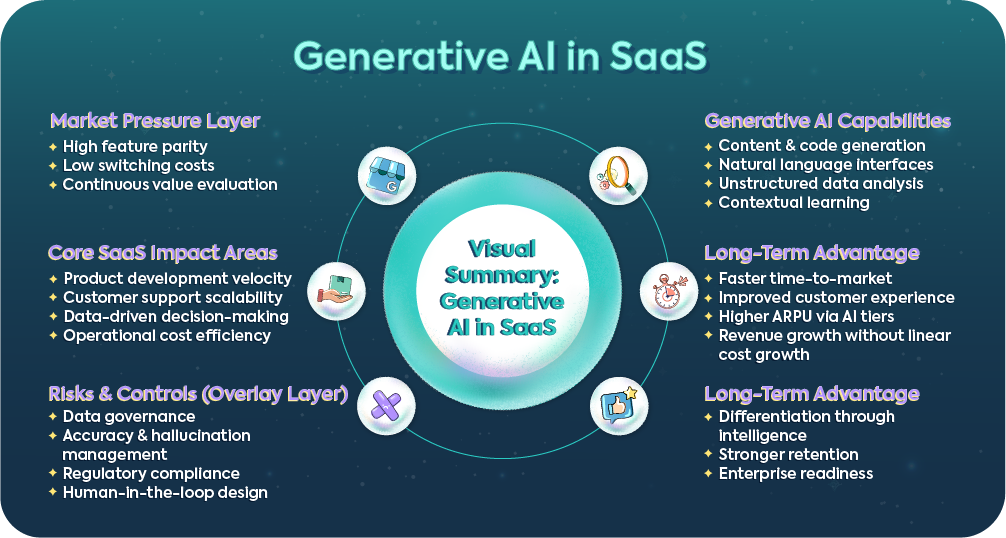

From a creative and strategic standpoint, generative AI delivers the most value when it is treated as part of the system design rather than a feature add-on.
The SaaS companies seeing durable gains are those aligning AI capabilities with product experience, brand trust, and clear business outcomes. Human oversight, thoughtful design, and clear communication remain essential, especially in customer-facing environments.
As SaaS markets continue to commoditize, competitive advantage will belong to teams that integrate generative AI with intention, clarity, and restraint, not simply speed.

Iris understands the dynamic nature of artificial intelligence. As such, our team stays up-to-date on the latest tools, tech, and developments to design a creative system that aligns with your brand principles and innovative processes.


Is generative AI necessary for SaaS companies today?
Generative AI is quickly becoming a baseline expectation in modern SaaS. As feature parity increases and switching costs remain low, AI enables faster innovation, smarter experiences, and scalable operations. SaaS companies that delay adoption risk falling behind on speed, adaptability, and customer expectations.
Where does generative AI have the greatest impact in SaaS?
Generative AI delivers the most consistent value in core operational areas such as product development, customer support, and data analysis. It accelerates release cycles, scales support without linear cost growth, and turns complex platform data into actionable insights.
Does generative AI guarantee immediate ROI?
No. While generative AI offers strong long-term advantages, immediate returns are not guaranteed. Research shows that successful outcomes depend on clear business alignment, data readiness, and disciplined execution. AI creates value when tied to measurable objectives, not when deployed as a standalone feature.
What risks should SaaS companies consider before adopting generative AI?
Key risks include data privacy and security, model accuracy, regulatory compliance, and over-automation in customer-facing workflows. These challenges underscore the need for strong governance, transparency, and human oversight throughout implementation.
How does IRIS help SaaS companies implement generative AI?
IRIS helps SaaS companies design and integrate generative AI as part of their operating system, not just a feature. We align AI capabilities with product experience, brand trust, and business goals, ensuring adoption is intentional, scalable, and built for long-term competitive advantage.