The artificial intelligence market, comprising the global software segment and AI-enabled software tools, is estimated to be approximately $97.7 billion in 2024 and projected to be more than $534 billion by 2030 with a CAGR of approximately 31.9%.
The SaaS market remains in a state of rapid growth, and cloud-based services are now the default software model for both enterprise and startup delivery. The merger of AI and SaaS is not just a fad; it is a paradigm shift in the construction, distribution, and consumption of software.
With AI software revenue growth gaining momentum, reaching hundreds of billions, machine learning, predictive analytics, and automation are becoming increasingly integrated into SaaS platforms.
New users are expected not to prefer the old static dashboards and manual workflow. They want smart systems, which learn, develop, anticipate, and make decisions instantly. SaaS is changing software as an active partner using AI technology.
The question for SaaS companies is not whether to incorporate AI but how best to strategically incorporate the necessary AI capabilities that can be used to create quantifiable business value.

The integration of artificial intelligence improves SaaS in three basic ways:
- Repetitive tasks are automated.
- Enhancement of human judgement.
- Personalization at scale
Conventional SaaS systems store and present data. AI-based SaaS systems understand it. This transformation brings software to active intelligence as opposed to reactive functionality.
The following are key AI characteristics that define the future of SaaS products.

Modern SaaS is no longer just about delivering functionality in the cloud; it’s about delivering intelligence at scale. As markets mature and competition intensifies, users expect products that not only respond but also anticipate, automate, and optimize.
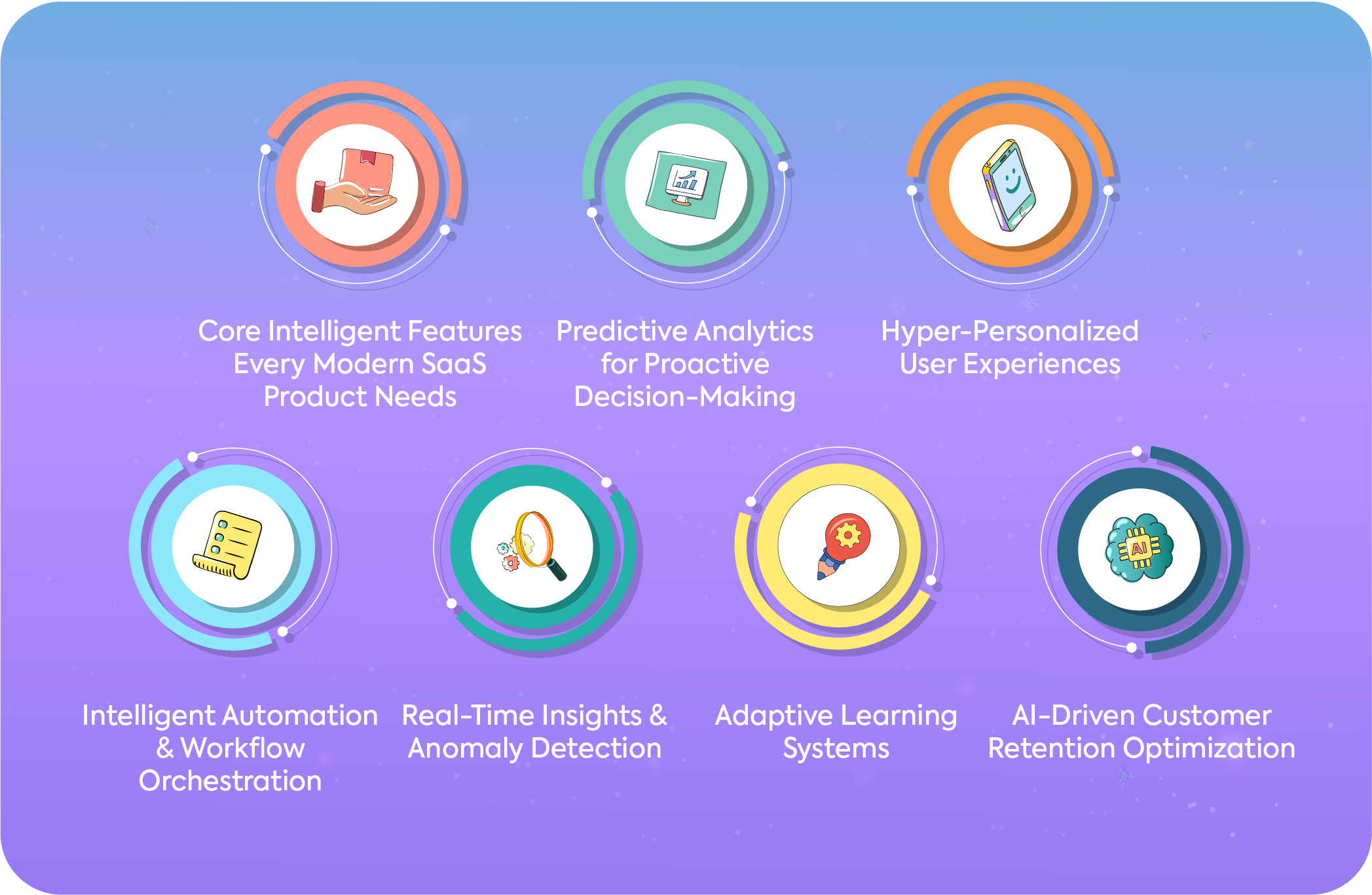
From embedded AI to real-time analytics and adaptive workflows, intelligence has become the new baseline. The SaaS products that win in 2026 aren’t just tools, they’re decision-making partners.

Predictive analytics involves the use of past information, usage indicators, and machine learning applications to predict the future. AI-powered SaaS anticipates the next likely move instead of reporting what has been happening.
Examples include:
- Predicting customer churn
- Predicting the sales performance.
- Demand forecasting of infrastructure.
- Identifying fraud risks
SaaS platforms provide users with an opportunity to move beyond problem-solving on the fly to a proactive strategy to executions by integrating predictive models.

SaaS platforms can customize interfaces, workflows, and suggestions to every individual user using AI.
Personalization can be in the form of:
- Role-based and usage behavior dynamic dashboards.
- Recommendations of content based on historical interaction.
- Personalized onboarding experience.
- Workflow proposals that are automated.
This makes the activity more interesting, with less friction; time-to-value is an important SaaS retention measurement.

AI-driven automation is much more than rule-based triggers. Machine learning systems work on patterns and optimize workflows independently.
For example:
- Intelligent ticket routing on support systems.
- Invoking invoice classification via robo fintech SaaS.
- CRM systems lead scoring.
- Smart task prioritization within project management software.
This lowers the cost of operation and enhances speed and accuracy.
Conversation interfaces reduce technical barriers and democratize access to data in organizations.

The contemporary SaaS solutions create enormous amounts of data. AI monitors streams in real time and identifies anomalies in real time.
Use cases include:
- Fraud detectives in financial SaaS.
- Cybersecurity alert of security anomalies in systems.
- Revenue deviation analytical tool.
- DevOps SaaS failure prediction.
Live intelligence helps to avert petty problems from becoming expensive disasters.

SaaS driven by AI gets better with time. The more users use platforms, the more the algorithms are refined to be more accurate in their predictions, their performance, and their recommendations.
Adaptive systems also guarantee that products develop together with user behavior that brings compounding competitive advantage.

One of the most important growth engines of the SaaS business is customer retention, and AI has a potent force in enhancing customer retention. The AI models will be able to detect the early signs of churn through the analysis of behavioral data (the frequency of logging in, the frequency of using the features, the number of support tickets, and the history of subscriptions).
Rather than responding to customer cancellations, SaaS platforms can activate proactive actions such as individualized offers, one-on-one onboarding, or an automated engagement campaign.
AI also classifies users by value and risk to enable teams to focus on high-impact accounts. This is a retention strategy powered by data that maximizes lifetime value (LTV) and minimizes acquisition dependency.

Salesforce, with its AI engine, Einstein AI, is among the most powerful real-life applications of AI implemented in SaaS architecture.
Salesforce incorporated AI in its CRM system to provide:
- Predictive lead scoring
- Opportunity forecasting
- Automated email insights
- Smart customer segmentation.
Einstein AI processes millions of CRM data points to find patterns that human sales teams may be missing. By bringing predictive information to the workflow, Salesforce turned its SaaS platform into a data management tool and an intelligent sales assistant.
Salesforce reports indicate that many businesses that use Einstein AI have reported an increase in conversion rates and productivity.
This case demonstrates the importance of integrating AI as part of the core capability rather than as an addition to enhance product differentiation, customer value, and revenue growth.

The use of AI in SaaS will not merely involve the incorporation of a chatbot. It requires systematic planning.
1. Identify High-Impact Use Cases
- Begin with customer pain point analysis:
- Where do the users have friction?
- What are the time-consuming repetitive tasks?
- What are the most important decisions that depend on data analysis
Prioritizing AI features directly affects revenue, retention, or efficiency.
2. Strengthen Data Infrastructure
Data that AI learns can only be as good as AI. Since cloud architecture is scalable, it offers a strong foundation to build data infrastructure.
SaaS companies must:
- Centralize data pipelines
- Enforce data purity and integrity.
- Introducing effective governance policy.
- Keep the privacy of users and meet regulations.
3. Integrate AI into Core Workflows
Do not regard AI as a separate feature tab. Rather, incorporate it into the primary product path.
Examples:
- Display prophesies on dashboards.
- Provide recommendations in the current workflows.
- Automate user interface activities
- Easy assimilation leads to adoption.
4. Focus on Explainability and Trust
Users should know the reasons behind AI giving some recommendations. Long-time adoption will depend on trust.
Best practices include:
- Explanation of transparent models.
- The indicators of confidence scores.
- Editable AI suggestions
- Clear opt-out mechanisms
5. Measure Performance and Iterate
Measure AI effects with:
- A reduced manual workload.
- Increase in feature usage
- Increase in retention rates.
- Increase in average revenue per user (ARPU).
This is necessary to constantly optimize.
6. Build Cross-Functional AI Teams
Effective AI SaaS products need the incorporation of:
- Product managers
- Data scientists
- UX designers
- Engineers
- Compliance specialists

Greater Customer Retention
AI-powered personalization and predictive capabilities make SaaS platforms more intuitive and indispensable. When systems anticipate user needs, recommend next steps, and adapt based on behavior, they create a seamless experience that increases stickiness. The more embedded a product becomes in daily workflows, the higher the switching cost, leading to stronger long-term retention.
Operational Efficiency
AI-driven automation reduces manual workloads, streamlines repetitive tasks, and minimizes operational overhead. From automated reporting to intelligent process optimization, embedded AI enables teams to focus on strategic initiatives rather than routine execution. This not only improves productivity but also enhances scalability without proportionally increasing costs.
Intelligent Features Enable Premium Pricing
Advanced capabilities such as predictive analytics, smart automation, and real-time insights elevate a product’s perceived value. Customers are willing to pay more for tools that drive measurable outcomes rather than simply providing access. AI-embedded features, therefore, support higher subscription tiers and stronger revenue models.
Data Network Effects
As more users engage with an AI-powered system, more data is generated, improving algorithm accuracy and performance. This continuous learning loop strengthens the product over time, creating compounding value. The result is a self-reinforcing system where scale directly enhances intelligence.
Competitive Differentiation
While individual features can be replicated, proprietary data models and accumulated AI insights are significantly harder to copy. Early adopters of AI-embedded SaaS build defensible advantages that strengthen over time. By integrating intelligence at the core of the product, companies secure credible and sustainable market positions.

At Iris Creatives, we don’t see AI as an add-on to SaaS; we see it as the force reshaping how software is built, positioned, and experienced.

Over the next decade, SaaS platforms will move beyond dashboards and prompts. They’ll execute multi-step workflows independently, from data analysis to decision implementation. The winners will be products designed with intelligence at the core, not layered on as a feature. This shift demands thoughtful product strategy, UX clarity, and AI-human balance, exactly where creative and technical alignment becomes critical.

Generic AI will give way to verticalized intelligence. We’ll see SaaS platforms powered by industry-trained models tailored to niche markets, healthcare, fintech, legal, logistics, and beyond. Differentiation will come from domain depth, proprietary data, and clear category positioning. Brands that articulate this specialization effectively will dominate their segments.

As AI becomes more embedded in decision-making, regulatory oversight will intensify. Transparency, explainability, and compliance will no longer be optional. SaaS companies will need clear communication frameworks, not just technically sound systems, but messaging that builds trust with users and stakeholders.

Ethical implementation will shift from internal policy to external expectation. Customers will choose platforms that demonstrate responsible data usage, fairness, and accountability. In this landscape, brand credibility and thought leadership around ethical AI will be as important as the technology itself.

The future of digital workplaces isn’t AI replacing humans; it’s AI amplifying them. Intelligent SaaS will act as a co-pilot: enhancing creativity, accelerating decisions, and optimizing operations while keeping humans in control. Designing this collaboration layer, intuitive, empowering, and strategically aligned, will define product success.
AI will not replace SaaS. It will transform it. And the companies that integrate intelligence into product, brand, and experience from day one will lead the next wave of growth

- How is AI-powered SaaS different from conventional SaaS?
Traditional SaaS delivers cloud-based software. AI-powered SaaS adds intelligence by using predictive models, automation, and personalization to continuously learn from user behavior and optimize performance over time.
- Is integrating AI into SaaS expensive?
Costs vary, but modern AI infrastructure and APIs make integration more accessible. Companies can start with focused features, measure ROI, and scale gradually to reduce upfront risk.
- How does AI impact customer retention?
AI improves retention through personalization, churn prediction, smart recommendations, and automated support, creating more engaging and sticky user experiences.
- What risks come with implementing AI in SaaS?
Key risks include data privacy concerns, algorithmic bias, regulatory compliance challenges, and over-automation. Strong governance, transparency, and human-centered design help mitigate these issues.
- How can Iris Creatives help SaaS companies embed AI effectively?
Iris Creatives helps SaaS brands integrate AI strategically, not just technically. From identifying high-impact use cases to designing intelligent user experiences and positioning AI features for premium growth, our plans combine product thinking, AI strategy, and category-driven branding. The result is scalable intelligence that drives retention, differentiation, and long-term revenue.