Software as a service is at the core of business operations across industries. From logistics to project management and even entertainment, the usefulness of SaaS isn’t just limited to work and business; it has become a part of everyday life for most.
Let’s take a look at the statistics:
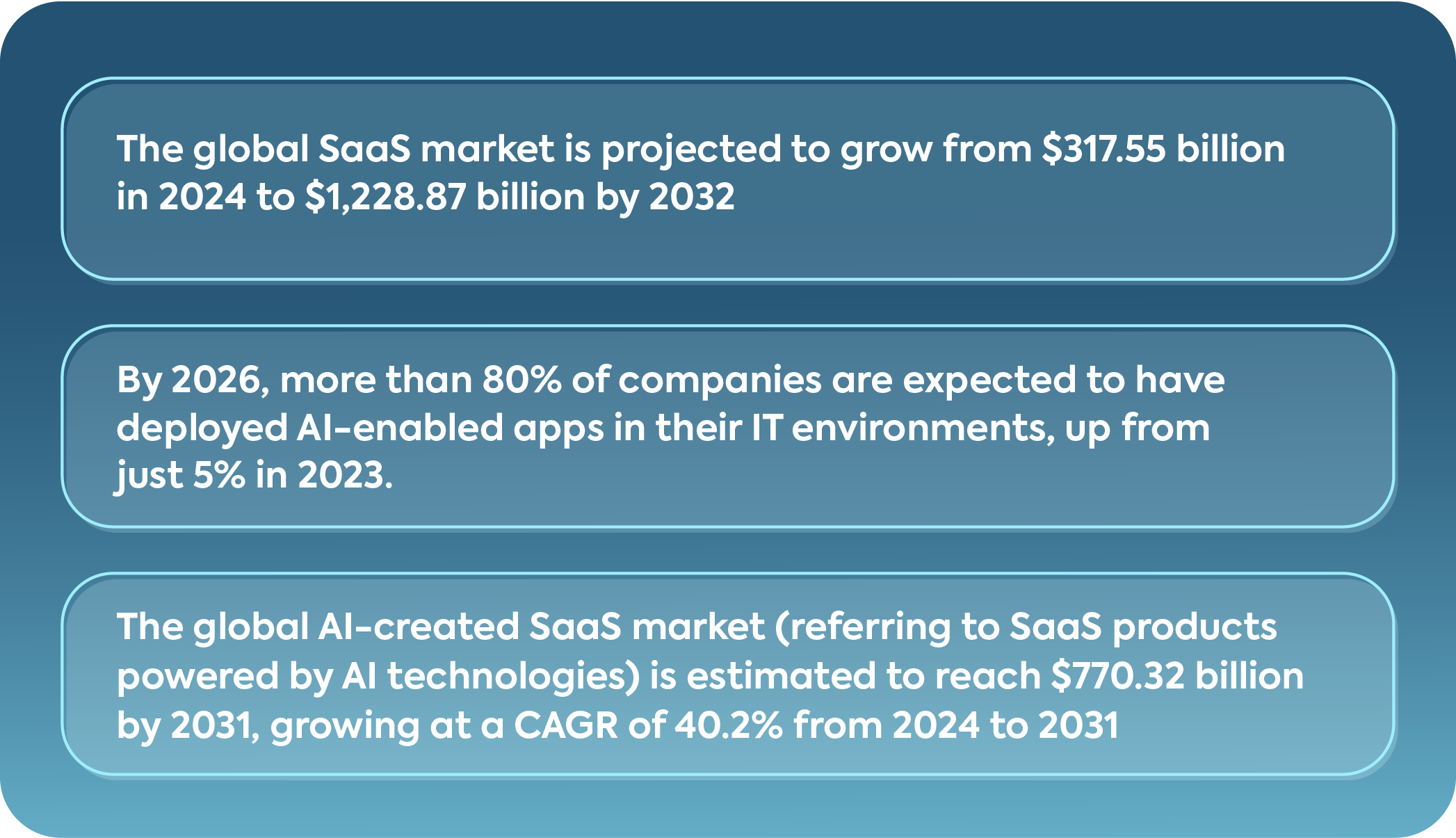
As the numbers suggest, the market is rapidly growing, and SaaS offers a lucrative opportunity for growth and business initiatives. That said, understanding how the industry operates, the ins and outs of revenue in the software landscape, and how to get started is quite the challenge.
This is primarily due to the intimidating nature of this discipline. Software was often perceived as complex and difficult to understand. The computing, the technical skill, and corresponding activities involved in creating a SaaS based product seemed more challenging than other businesses.
However, with cloud computing, generative AI, and creative capabilities becoming more accessible, SaaS is an attractive space for startups and founder-led businesses. For clarity, let’s take a look at how industries have grown compared to SaaS:
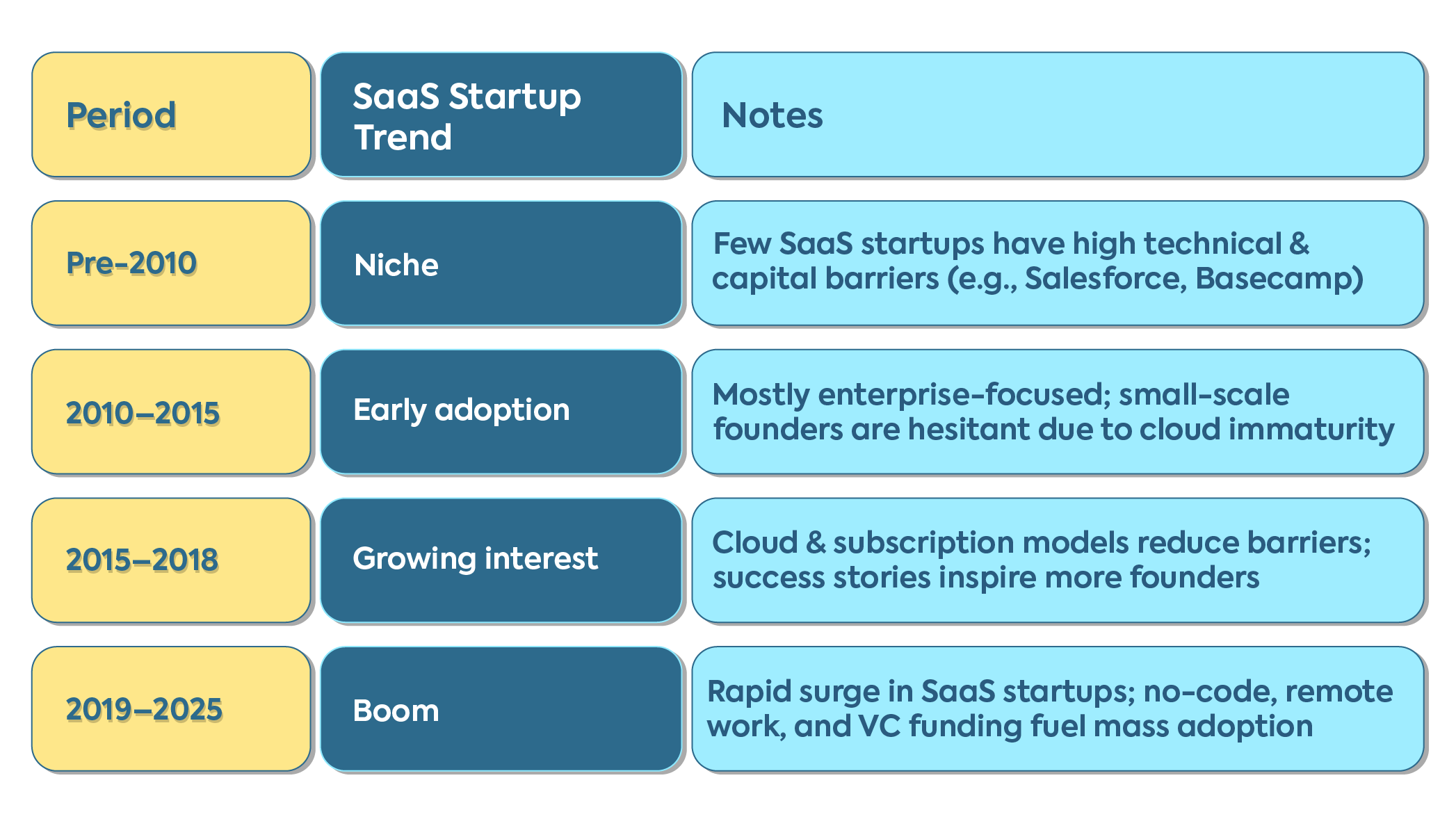
As an industry poised to generate millions, it is one of the most lucrative spaces to consider for business opportunities.
Software as a service is an umbrella term. This means it has several sub-categories that can be considered as business opportunities. These are software that other businesses use to improve efficiency at a recurring fee.
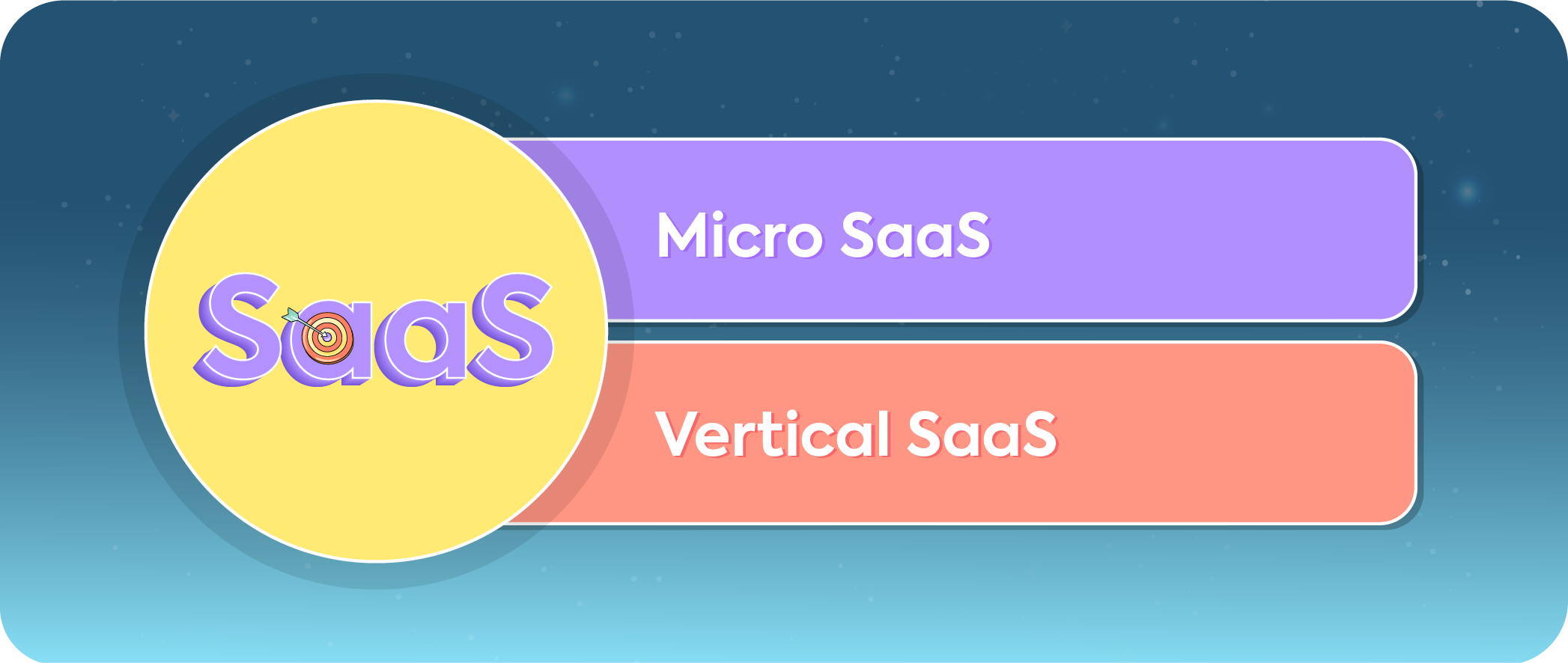
SaaS Models Beyond the Buzzwords
It is essential first to understand how SaaS models create value and where they fall short before exploring the concepts of launching.
Horizontal SaaS: Scale with Fragility
Horizontal SaaS products are offered to the general market in different industries (e.g., CRMs, accounting tools, project management software). Although they enjoy huge total addressable markets (TAMs), they also incur expensive customer acquisition costs (CAC). Competing user demands necessitate feature bloat, high levels of competition from competitors, and a reliance on ongoing capital investment.
Horizontal SaaS firms tend to grow more than be sustainable, heavily depending on venture capital to cover initial losses.
Vertical SaaS: Depth Over Breadth
Vertical SaaS is specifically targeted at industry workflows, such as software tailored to the needs of legal firms, construction firms, medical institutions, or logistics firms. These platforms exchange the market size with domain knowledge and stickiness.
Vertical SaaS advantages include significantly reduced churn due to workflow integration. Higher willingness to pay. Reduced competition. More powerful word-of-mouth expansion.
Vertical SaaS will be more profitable in 2026 than horizontal SaaS, not because of the hype of valuation.
Micro SaaS: The Anti-Unicorn Strategy
Micro SaaS has been confused with small SaaS. It is actually an efficient philosophy of capital, rather than a size limitation.
Micro SaaS products typically have one special problem that is solved exceptionally well, and are constructed and managed by small teams or individual founders. Create stable, predictable cash flow. Do not get addicted to venture capital. The cost is the reduced rate of growth, but tremendously greater founder control and resilience.
A Look at the Evolution of SaaS through its Application
One of the most widely used Software as a service is Salesforce. In 1999, enterprise software was dominated by expensive, on-premise systems that required heavy upfront licenses, long implementation cycles, and dedicated IT infrastructure. CRM solutions like Siebel were powerful but complex, costly, and slow to deploy.
Salesforce challenged that model. Instead of selling software as a one-time product, Salesforce delivered CRM through the cloud on a subscription basis, accessible via a web browser, with no installation required. This dramatically reduced upfront costs, shortened sales cycles, and allowed businesses of all sizes to adopt enterprise-grade tools.
What Changed:
- Lower Barrier to Entry: Subscription pricing replaced large capital expenditures.
- Faster Innovation: Continuous cloud updates eliminated version upgrades and long release cycles.
- Predictable Revenue: Recurring revenue created stable, scalable growth.
- Scalable Infrastructure: Customers could grow without rebuilding their tech stack.
The result? Salesforce became one of the fastest-growing enterprise software companies in history and helped validate SaaS as a viable and superior business model.
The Maturity Paradox of SaaS in 2026
By 2026, SaaS will have ceased being a new or disruptive industry; it will be a default infrastructure layer both to businesses and individuals. This creates a paradox. On the one hand, the obstacles to software construction have been lowered due to cloud services, application programming interfaces, and generative artificial intelligence.
Conversely, competition is stiffening, customer expectations are growing, and differentiation is also becoming more challenging.
The common fallacy of most founders is that SaaS growth equals opportunity. As a matter of fact, market maturity squeezes margins, raises the churn risk, and rewards undifferentiated products. The SaaS opportunity in 2026 is not to create more software, but to create more relevant, narrower, and outcome-oriented software.
Why 2026 Is a Pivotal Year for SaaS Founders
AI Saturation Will Force Differentiation
By 2026, AI will cease being a selling feature, and it will become a necessity. The only products that make AI features but not outcomes will not perform.
Critical Shift
The purchasers of SaaS will consider the outcomes, rather than functions.
SaaS powered by AI should have demonstrated an effect that saved time, reduced cost, increased revenue, and minimized risk.
Subscription Fatigue Will Reshape Pricing Models
Consumers are less willing to deal with dozens of subscriptions that they have to handle. This puts a strain on SaaS companies to bundle value, offer usage-based pricing, and justify recurrent costs constantly.
Micro SaaS products, which provide mission-critical automation, will not die out. Nice-to-have tools will not.
SaaS and Micro SaaS Ideas to Consider in 2026
In 2026, SaaS is no longer just about building software; it’s about solving narrow, high-value problems with speed, automation, and intelligence. As markets mature and AI becomes embedded in everyday workflows, the biggest opportunities are shifting toward focused, outcome-driven solutions rather than broad, all-in-one platforms.
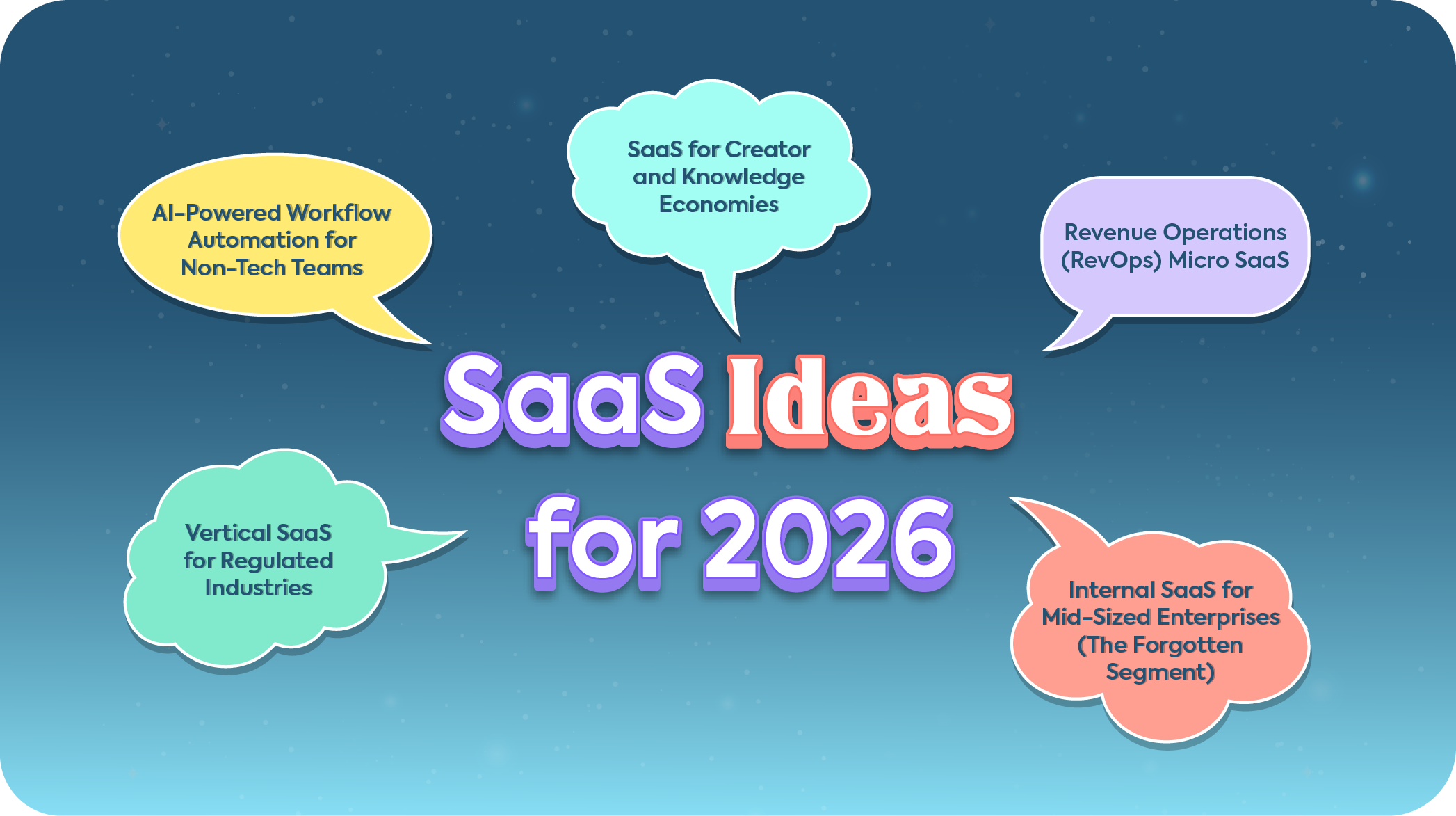
From industry-specific tools to AI-powered micro products, both SaaS and Micro SaaS models offer scalable, capital-efficient ways to build recurring revenue. The key is identifying underserved niches, simplifying complex workflows, and delivering measurable value fast.
1. AI-Powered Workflow Automation for Non-Tech Teams
Problem:
The non-technical departments (HR, procurement, compliance, operations) are bombarded with a disjointed set of tools and manual processes.
Opportunity:
Generalized automation tools will be underperformed by micro-SaaS that automates a single workflow on an end-to-end basis, e.g., onboarding compliance, vendor risk assessment, etc.
Critical Insight:
AI sophistication is not the value but the ownership of a process. When automating the workflow, the founders should have a profound knowledge of it.
2. Vertical SaaS for Regulated Industries
The generic SaaS is underused in highly regulated industries, including healthcare, fintech, education, and energy.
Why this matters in 2026:
The complexity in regulation raises the switching costs. Automation of compliance has become a requirement. Any SaaS tools are generic in natur
Example opportunities:
Audit-readiness platforms, automation of regulatory reporting, and license and certification monitoring systems.
Critical Risk:
Trust and adoption can be ruined by neglect of the validation of legal and compliance.
3. Internal SaaS for Mid-Sized Enterprises (The Forgotten Segment)
Enterprise SaaS targets big business. Micro SaaS is frequently focused on startups. The mid-sized companies (50 to 500 employees) are underserved.
They need personalized tools that are not as costly as an enterprise, more analytics without data science forces, and intricate integration and automation.
Strategic Advantage:
Mid-market customers are not as price-sensitive as startups and are driven by loyalty.
4. Revenue Operations (RevOps) Micro SaaS
The data of sales, marketing, and customer success is still scattered between tools.
Opportunity:
Micro SaaS tools that lie between CRM, billing, and analytics solutions without substituting these tools provide high value. Micro-tools of churn prediction. Forecasting of contract renewal. Sales pipeline leakage analysis
Critical Differentiator:
Displaying insights, not dashboards. The founders need to minimize cognitive load rather than maximize it.
5. SaaS for Creator and Knowledge Economies
The creator economy has grown beyond the influence of independent educators, consultants, and niche experts.
Unmet needs include IP protection, revenue forecasting, subscription optimization, and community health analytics. Generic platforms are scale-driven, as opposed to creator sustainability.
Micro SaaS Advantage:
The smaller the creator niche (e.g., cohort-based educators or those who write paid newsletters), the more relevant and retentive.
Lessons from SaaS Applications: Strategic Implications for 2026 Founders
The SaaS market in 2026 is maturing. With global SaaS revenue continuing to grow and competition intensifying, the easy wins are gone. What worked in 2016, broad positioning, aggressive funding, and acquisition-first growth, no longer guarantees survival.
The next generation of SaaS companies will be built differently. They will be sharper, leaner, and more strategically aligned with customer value.
But to achieve success in 2026, SaaS must be adaptable. The CRM category is saturated; a founder-focused SaaS product, on the other hand, is a lucrative opportunity.
Key Challenges New SaaS Founders Might Face in 2026
1. The Discoverability Crisis
SaaS isn’t just competitive in 2026, it’s overcrowded. App marketplaces, search engines, and SaaS directories are saturated with similar tools fighting for the same attention. Organic discovery is no longer something you can rely on.
Simply building a great product is not enough. If people can’t find you, you don’t exist.
The strategic response? SaaS founders must move beyond traditional marketing tactics and lean into community-driven growth, founder-led content, and strategic niche partnerships. Trust-based distribution is replacing algorithm-dependent visibility.
The brands that win are the ones embedded in conversations, communities, and ecosystems, not just search results.
2. Retention Over Acquisition
Churn is the silent killer of SaaS businesses. In mature markets, customer acquisition alone cannot sustain growth. Retention now matters more than ever.
Winning SaaS companies understand that long-term profitability comes from keeping customers engaged, not just signing new ones.
Retention strategies in 2026 must include:
- Behavioral analytics to understand usage patterns
- Proactive engagement before customers disengage
- Continuous value demonstration through updates, education, and support
The real growth engine is not acquisition. It’s expansion revenue and long-term loyalty.

Vanity metrics will mislead founders in 2026. High traffic, downloads, or free signups mean little without sustainable revenue performance.
The metrics that truly matter include:
- Net Revenue Retention (NRR)
- Customer Acquisition Cost (CAC) payback period
- Feature adoption depth
- Customer Lifetime Value (LTV) stability
For Micro SaaS founders, especially, profitability per customer is more important than growth at any cost. Sustainable economics will outperform inflated top-line growth every time.

The idea that SaaS automatically requires venture capital is becoming outdated. However, the decision between bootstrapping and VC funding must be strategic, not emotional.
Benefits of Bootstrapped SaaS
Bootstrapped companies maintain full ownership, grow sustainably, and build incentives aligned with long-term profitability. Without external pressure to scale prematurely, founders can focus on product quality, customer relationships, and operational efficiency.
Risks of VC-Backed SaaS
Venture funding brings capital, but also pressure. Growth expectations, aggressive scaling, and potential loss of strategic control can push startups into unstable territory. Premature scaling remains one of the biggest causes of failure.
By 2026, many durable Micro SaaS companies will be those built patiently and profitably, not those that raised the most money.
The Real Opportunity in SaaS 2026
The SaaS market isn’t saturated; it’s misaligned. Most failed products don’t fail because the market is full. They lose because they solve vague problems, target overly broad audiences, compete on features instead of outcomes, and ignore operational realities.
The winners in 2026 will:
- Choose narrow, well-defined problems
- Serve specific user groups deeply
- Optimize for measurable results, not publicity
- Build resilient, sustainable businesses
SaaS is no longer just about building software. It’s about engineering value delivery at scale — consistently, profitably, and strategically.
SaaS with Iris in 2026
By 2026, SaaS is no longer a race to launch; it’s a strategic decision to differentiate. AI is expected. Cloud is standard. Subscriptions are scrutinized. What separates winners from the noise is not features, but focus. SaaS with Iris means building with intention.
It means identifying a narrow, high-value problem and positioning it clearly in the market. It means designing product experiences that reduce friction and cognitive load. It means crafting messaging that speaks to outcomes, not functionality. And it means creating a brand that earns trust before a demo is ever booked.
At Iris Creatives, we work with SaaS and Micro SaaS founders to align product, positioning, design, and growth into one cohesive strategy. From category-first branding and UI/UX systems to AI-powered content and go-to-market clarity, we help transform software into a scalable, defensible business.

Is SaaS still a profitable business model in 2026?
Yes. The SaaS market continues to grow rapidly, especially with AI integration becoming standard across industries. However, profitability now depends on solving specific, high-value problems rather than launching broad, generic tools.
What is the difference between SaaS and Micro SaaS?
SaaS refers to software delivered on a subscription basis, often serving wide markets. Micro SaaS focuses on solving one narrow problem extremely well, usually run by small teams or solo founders, with an emphasis on efficiency and profitability.
Do I need advanced technical skills to start a SaaS business?
Not necessarily. Cloud infrastructure, no-code tools, APIs, and generative AI have significantly reduced technical barriers. What matters more in 2026 is understanding the user’s workflow and delivering measurable outcomes.
What makes a SaaS product successful today?
Successful SaaS products prioritize retention, clear ROI, workflow ownership, and strong positioning. Customers now evaluate software based on results, not feature lists.
How can Iris Creatives support SaaS founders?
Iris Creatives helps SaaS and Micro SaaS founders with branding, positioning, UI/UX design, AI-powered content, and go-to-market strategy. We focus on building differentiated, conversion-driven, and growth-ready SaaS brands that stand out in competitive markets.